Gas Cost Calculator for Delivery Drivers: What Your Miles Really Cost (2026)
In this article
Gas is the delivery driver's biggest out-of-pocket expense, and most drivers only know it as a weekly sting at the pump — not as a cost per mile they can actually manage. The math is one line: miles ÷ MPG × price per gallon. What's been missing is a calculator built around delivery numbers instead of road trips.
Your gas cost, in three steps
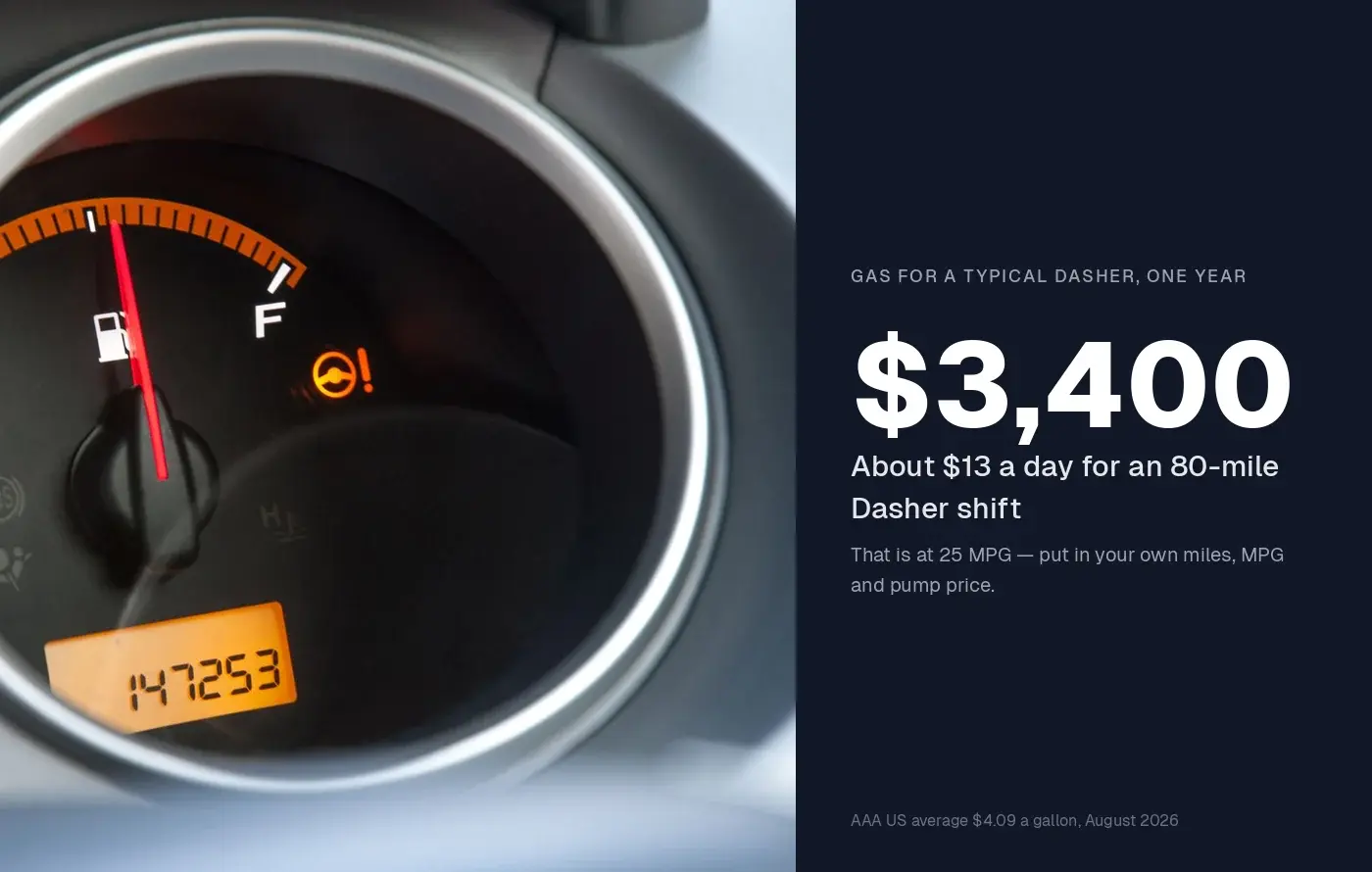
- 1Divide your daily miles by your car's real-world MPG to get gallons burned — a typical 80-mile Dasher day in a 25 MPG car is 3.2 gallons.
- 2Multiply by your local price per gallon. At the August 2026 US average of $4.09 (AAA), that's $13.09 per day — 16.4¢ per mile.
- 3Multiply out your schedule: at 5 days a week, that one line becomes roughly $65/week, $284/month, and $3,400/year.
Numbers use the AAA national average of $4.09/gallon (August 27, 2026). Use the calculator below with your own miles, MPG, and local price.
The calculator
Defaults are set to a typical full-shift delivery day — 80 miles, 5 days a week, a 25 MPG car, and the current US-average gas price. Change any input and every number updates.
Gas cost calculator
$4.09 = US average, August 2026 (AAA)
Your gas spend
$13.09
Per day
$65.44
Per week
$283.57
Per month
$3,403
Per year
Gas cost per mile: 16.4¢
With 15% fewer miles (what route optimization typically saves): $510.43/year back in your pocket
Two things jump out when drivers run their own numbers. First, the vehicle matters enormously: the same 400-mile week costs about $1,700 a year in a Prius and $4,250 in a 20 MPG SUV. Second, the yearly number is always bigger than expected — daily gas feels like lunch money, but it compounds into a used-car-sized expense.
How to find each input
The calculator is only as honest as what you feed it. Here's where to get real numbers instead of guesses.
Miles per day — trust your odometer, not the app. DoorDash doesn't track your mileage for you, and the estimates inside gig apps only count the delivery itself — not the drive back from a drop-off, repositioning between hotspots, or circling for parking. Note your odometer at the start and end of one normal week and divide by days worked. Drivers who do this usually find their real miles run well above the in-app figure; self-reported full-shift Dasher logs range from about 75 to 290 miles a day depending on market and hours.
Days per week. Count days you actually drive, including short weekend shifts — a 3-hour Sunday dinner rush still burns gallons.
Vehicle MPG — measure it, don't use the sticker. Delivery driving is stop-and-go with the engine idling at restaurants, so real MPG lands below the EPA combined rating. The reliable method: fill the tank, reset the trip odometer, drive normally, and at the next fill-up divide trip miles by gallons pumped. Do it across two or three fill-ups of delivery driving and you have your true number. (For a starting point, fueleconomy.gov lists EPA ratings for any model year.)
Local gas price. The calculator defaults to the AAA national average — $4.09/gallon as of late August 2026, the most expensive August on record. Your state can sit far from the average, so check AAA's state-by-state table or a price app and enter what you actually pay.
A worked example: the typical Dasher
Take a full-time Dasher running dinner-and-lunch shifts at the calculator's defaults — 80 miles a day, 5 days a week, in a 25 MPG car:
| Amount | |
|---|---|
| Gallons per day | 3.2 |
| Gas per day | $13.09 |
| Gas per week (400 mi) | $65.44 |
| Gas per month | $283.57 |
| Gas per year (20,800 mi) | $3,402.88 |
| Gas cost per mile | 16.4¢ |
Now put that against earnings. Gridwise data across 115,000+ active Dashers puts gross pay around $1.04 per mile driven. At 16.4¢ of gas per mile, fuel alone eats roughly 16% of gross earnings — before a single other car expense. Drive a 20 MPG SUV and that jumps to about 20 cents and a fifth of gross.
The real cost per mile is much bigger than gas
Here's the caveat every driver needs taped to the dashboard: gas is only part of what a mile costs. Every mile also burns tires, oil, brakes, maintenance, and — the silent one — depreciation.
The IRS's estimate of what a business mile really costs is the standard mileage rate, and for 2026 it's the highest ever: 72.5 cents per mile for January–June, raised mid-year to 76 cents per mile for July 1 through December 31, 2026. At our default inputs, gas is 16.4¢ of that — barely more than a fifth of the full rate. AAA's Your Driving Costs 2025 study tells the same story from the ownership side: fuel averaged just 13 cents of a total per-mile cost that approaches 77 cents for a newer vehicle.
Two practical consequences:
- Judge orders per mile, not per hour. A $7 order that takes you 12 miles pays 58¢/mile — below the IRS's own estimate of what the mile costs you. That order is likely a net loss, even though the gas alone "only" cost $1.97.
- Track every mile for taxes. As an independent contractor you deduct the full standard rate. At 76¢/mile, the 20,800-mile year in our example is a ~$15,800 deduction — miss logging even 20 miles a day and you're leaving four figures unclaimed.
The lever that actually works: drive fewer miles
You can't change the price of gas, and squeezing an extra 1–2 MPG through tire pressure and gentle acceleration is real but small. The lever that moves the yearly number is miles:
- Zone discipline. Stay inside a tight delivery zone instead of chasing orders that drag you to the far side of town, then decline the trip back empty.
- Per-mile order screening. Set a floor (many drivers use $1–2/mile) and let anything under it go.
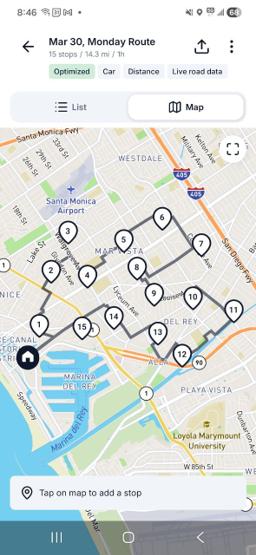
- Route optimization for stacked and multi-stop runs. Whenever you hold more than two stops — stacked food orders, a Flex block, catering runs — stop order is the difference between backtracking across town and one clean loop. Industry data consistently shows optimized routes cut 10–15% of miles; that's the assumption behind the calculator's savings line, and at the default inputs it's worth about $510 a year in gas alone — more again in unclocked time and wear.
The calculator shows what your miles cost; the companion guide — how to save gas driving for DoorDash — walks through cutting them, and a route planner does the sequencing math for you on every multi-stop run.
FAQ
How much does gas cost per mile? Local price per gallon ÷ MPG. At the August 2026 US average of $4.09: a 25 MPG car pays 16.4¢/mile, a 30 MPG sedan 13.6¢, a 20 MPG SUV 20.5¢, a 50 MPG Prius 8.2¢.
How do I calculate gas cost for a delivery route? Route miles ÷ MPG × price per gallon. An 80-mile day at 25 MPG and $4.09/gallon = 3.2 gallons = $13.09.
How much do DoorDash drivers spend on gas per week? At 400 miles a week (80 × 5) in a 25 MPG car at $4.09/gallon: about $65 a week, $284 a month, $3,400 a year. The same miles in a 20 MPG SUV run about $82 a week.
Does DoorDash pay for gas? No — Dashers are contractors and cover their own fuel. The offset is the IRS mileage deduction: 76¢ per business mile for July–December 2026 (72.5¢ for January–June).
How can delivery drivers spend less on gas? Cut miles, not just price-per-gallon: tight zones, per-mile order screening, and optimized stop order on multi-stop runs (typically 10–15% fewer miles — about $510/year at average Dasher mileage).