How Many Stops Does an Amazon Driver Make a Day? The Real Numbers
In this article
Amazon doesn't publish how many stops its drivers make. Ask the drivers, though, and the answer is remarkably consistent — and higher than almost any other delivery job in the US.
The short answer
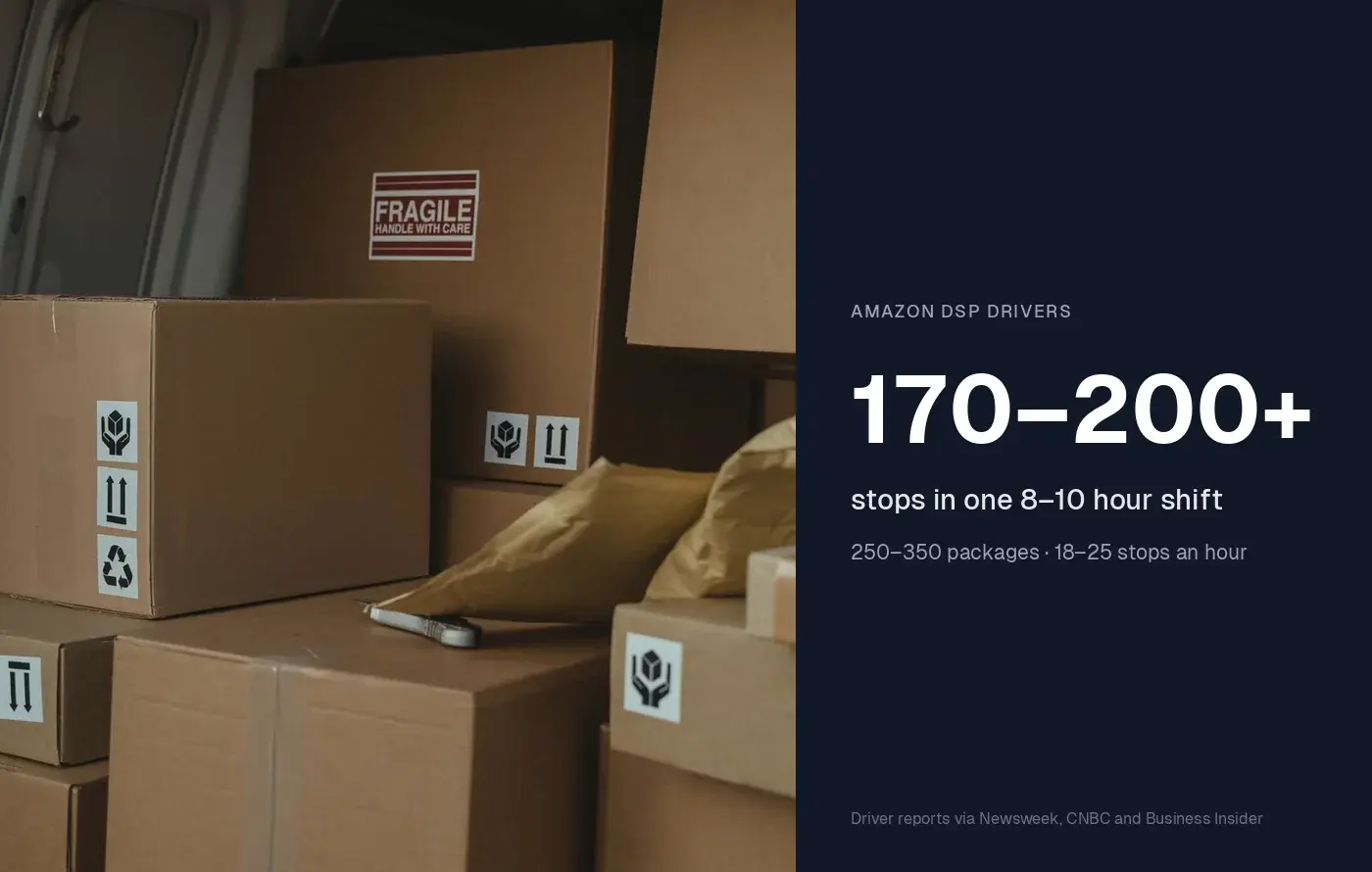
- 1Amazon DSP (van) drivers report 170–200+ stops and 250–350 packages in an 8–10 hour shift — roughly 18–25 stops per on-road hour.
- 2Amazon Flex drivers report about 35–50 stops in a typical 3.5–4 hour block — roughly 10–14 stops per hour.
- 3That is well above UPS (100–150 stops/day per Business Insider) and FedEx Ground (roughly 100–180 stops/day).
- 4These are driver-reported ranges, not official Amazon figures — Amazon publishes none.
Sources for every number are cited below: Newsweek (2022), CNBC (2021), Business Insider (2021), Amazon's own Flex FAQ, UPS's ORION materials and USPS Postal Facts (FY2025).
Amazon DSP drivers: 170–200+ stops a day
DSP drivers — the ones in Amazon-branded vans, employed by third-party Delivery Service Partners — carry the heaviest stop counts in the industry. Since Amazon releases no official numbers, the best data comes from drivers themselves and from journalists who checked:
- 180 stops, 326 packages. DSP driver Cameron Smiley's route went viral on TikTok in 2022: 326 packages across 180 stops, filling 21 delivery bags. "I don't know how they expect one person to deliver 326 packages to 180 stops," he said in the clip covered by Newsweek (August 8, 2022). The same article puts typical daily package counts at 170–375.
- 199 stops, 320 packages. A DSP driver in Lansing, Michigan told CNBC (June 21, 2021), speaking after a 10-hour shift, that her busiest day so far had been 199 stops and 320 packages.
- 170–350 packages per shift. DSP drivers told Business Insider in 2021 they were expected to deliver between 170 and 350 packages per shift — and DSP owners had asked Amazon to cap routes at 150 stops and 250 packages a day, which tells you how often routes ran above that.
- Reddit's r/AmazonDSPDrivers, where drivers post their route sheets daily, echoes the same band — routes in the 170–200 range are treated as normal, and peak-season routes past 200 stops are a recurring complaint.
Put together: a normal DSP day is 170–200 stops with 250–350 packages, and 200+ is common in peak season. Shifts typically run 8–10 hours — DSP job listings commonly advertise four 10-hour shifts a week.
One definition matters here: a stop is one address; a package is one box. A single stop can take three packages, which is why the package numbers run roughly 1.5–1.8× the stop numbers on Amazon routes.
Amazon Flex: 35–50 stops per block
Flex drivers deliver in their own cars in scheduled blocks. Amazon's own Flex FAQ says delivery blocks "are typically 3–6 hours" (2–4 hours for Amazon Fresh) and that "most delivery partners earn $18–25 per hour."
Stops per block, again, is not published — driver reports put a typical 3.5–4 hour block at roughly 35–50 stops. Guides aggregating driver experience (Ridester's Flex blocks guide, among others) describe about 40 packages as a normal 3.5-hour load, and drivers in New Jersey told reporters in 2024 that blocks in their market had grown from about 32 stops to as many as 50 for a 4-hour block.
That math lands Flex at about 10–14 stops per hour — lower than DSP vans mostly because Flex routes are less dense, and a car's cargo area forces more time hunting for the right package. If you drive Flex, we've broken down where those minutes go in our guide to finishing blocks faster.
Amazon vs. UPS, FedEx and USPS: the comparison
Delivery stops per day by service
- Amazon DSP170–200
Driver-reported; 200+ in peak
- FedEx Ground100–180
200+ in peak
- UPS100–150
UPS's own ORION materials cite ~120 average
- Amazon Flex35–50
Per 3–6 hour block, not per day
| Service | Stops/day | Packages/day | Shift length | Stops per hour |
|---|---|---|---|---|
| Amazon DSP | 170–200+ (driver-reported) | 250–350 (Newsweek, CNBC, Business Insider) | 8–10 h | ~18–25 |
| Amazon Flex | 35–50 per block (driver-reported) | ~40–70 | 3–6 h block (Amazon Flex FAQ) | ~10–14 |
| UPS | 100–150 (Business Insider); UPS's ORION materials cite ~120 average | not published; industry estimates ~120–300 | ~9 h (the Teamsters "9.5 rule" caps regular days at 9.5 h) | ~11–17 |
| FedEx Ground | 100–180, 200+ in peak (ClimbTheLadder, Nov 2025) | 75–125 (same source) | 8–10 h | ~11–20 |
| FedEx Express | 30–80 (same source) | — | 8 h | ~4–10 |
| USPS city carrier | ~720 delivery points per route on average (computed: 170.4M delivery points ÷ 236,347 routes, USPS Postal Facts FY2025) | mail + parcels | 8 h | not comparable — walking loops, mailbox-to-mailbox |
Three caveats so this table doesn't overclaim:
- Only USPS's figures are official. Amazon, UPS and FedEx publish no per-driver stop counts; those rows are driver reports, journalism, and careers-site estimates, each dated above.
- USPS isn't really comparable. A letter carrier "stops" at nearly every address on a walking loop — that's why the number is triple everyone else's. It measures a different job.
- UPS and FedEx stops are heavier. Their routes mix in commercial stops with many packages and pickup obligations, so fewer stops does not mean less work — it means differently shaped work.
The honest headline: Amazon vans make more individual stops per day than any other major US delivery service — typically 30–70% more than a UPS or FedEx Ground route — because Amazon routes are built almost entirely from single-package residential drops.
The stops-per-hour math
Stops per day hides shift length, so per-hour is the better benchmark:
Stops per on-road hour
- Amazon DSP18–25
- FedEx Ground11–20
- UPS11–17
- Amazon Flex10–14
- FedEx Express4–10
| Service | The math | Stops per hour |
|---|---|---|
| Amazon DSP | 170–200 stops ÷ ~8–9 on-road hours | 18–25 |
| FedEx Ground | 100–180 stops ÷ ~9 h | 11–20 |
| UPS | 100–150 stops ÷ ~9 h | 11–17 |
| Amazon Flex | 35–50 stops ÷ 3.5–4 h | 10–14 |
| FedEx Express | 30–80 stops ÷ 8 h | 4–10 |
A DSP driver averaging 20 stops per hour is completing a stop every three minutes — park, find the package among hundreds, walk it to the door, photograph it, and drive to the next address — sustained for eight hours. That pace is the entire explanation for both the numbers above and the turnover behind stories like Smiley's.
What actually determines your stops per hour
Whether you drive for a DSP, run Flex blocks, or deliver for your own customers, the same four factors set your ceiling:
- Stop density. 20 stops on one apartment-lined street is an hour's work; the same 20 stops spread across rural roads is half a day. This is the factor you control least — but it's why comparing your raw number to a dense-metro driver's is meaningless.
- Stop order. Every backtrack, double-covered street, and left turn across traffic is minutes lost at every occurrence. UPS built its ORION routing system around exactly this; by its own account the system evaluates over 200,000 route alternatives per driver to squeeze out miles. Amazon's Flex and DSP apps hand you a pre-computed order tuned to Amazon's costs — not to where you need to end your day.
- Parking and approach. In urban cores, finding somewhere to put the vehicle often takes longer than the doorstep. Experienced drivers plan stops so they walk clusters instead of re-parking three times on one block.
- Package findability. DSP vans use numbered bags for a reason: a stop where you find the box in ten seconds and a stop where you dig for two minutes are the same stop on paper, and a 25% difference in your day.
Amazon solves stop order and findability with industrial routing software and warehouse pre-sorting. That's the gap between an Amazon van's 20+ stops per hour and a typical independent courier doing 10.
Hitting DSP-level numbers without Amazon's software
Here's the part that matters if you're benchmarking yourself: the routing layer is the piece independent couriers and small fleets can actually replicate.
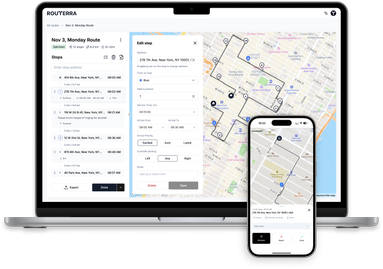
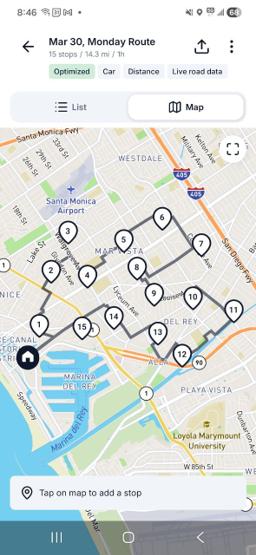
Density is fixed and parking is local knowledge, but stop order is pure software. A multi-stop route optimizer takes the same list of addresses and sequences them the way ORION or Amazon's planner would — minimizing backtracking, clustering walkable stops, and (unlike Amazon's planner) letting you choose where the route ends, such as back near home. Flex drivers using Routerra's screenshot import to re-order their blocks report saving 30–90 minutes per block — which, on a 45-stop block, is the difference between 11 and 14 stops per hour.
For a small fleet, the same math compounds across vans: two extra stops per hour per driver is an extra van's worth of capacity across a six-van operation — we've run those numbers in our route planning software pricing breakdown.
The bottom line
- Amazon DSP: 170–200+ stops, 250–350 packages, 8–10 hours — driver-reported, and unmatched in the industry.
- Amazon Flex: 35–50 stops in a 3.5–4 hour block, at a gentler 10–14 stops per hour.
- UPS / FedEx Ground: 100–180 stops, but heavier and more commercial per stop.
- No official Amazon figure exists — treat any site quoting a single precise number without a source accordingly.
And if your own stops-per-hour number is the one you care about: density is geography, but sequence is software — and that part is fixable this afternoon.