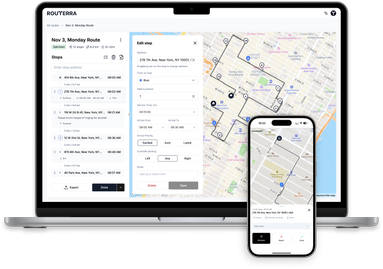
Routerra vs Spoke (formerly Circuit): Solo Driver to Full Fleet
In this article
Circuit is now Spoke — and the comparison changed
If you've been shopping for a route planner, you may have noticed Circuit is gone. In 2026 it rebranded to Spoke (spoke.com) and split into three products: Route Planner for solo drivers, Dispatch for fleets, and Connect. That's a sensible move — a lone courier and a dispatcher running six vans genuinely need different tools.
Routerra made the same split. There are now two products: Routerra Pro for the individual driver, and Routerra Teams for fleets. So the honest comparison isn't one app versus another anymore — it's two levels. This post walks both: solo (Spoke Route Planner vs Routerra Pro) and fleet (Spoke Dispatch vs Routerra Teams), so you can find the row that matches how you actually work.
We're not here to knock Spoke. It's a capable, well-known product. The goal is to show you where Routerra is a better fit — mostly on transparent pricing, an offline-first driver app, and proof-of-delivery and notifications that come included rather than as paid add-ons.
Solo: Spoke Route Planner vs Routerra Pro
If you're one person delivering your own route, this is your section.
Pricing and stops
Routerra keeps the solo tier simple: Pro is $14.99/month (or $119.99/year), with up to 200 stops per route and 20 optimizations per day. The free tier covers 20 stops and 5 optimizations a day (30 a month) — enough to try it on a real route before you pay anything.
Spoke's Route Planner is the direct descendant of the Circuit solo app. It handles the same core job — take your stops, put them in a sensible order, guide you through the day. Pricing and stop limits shift as products get renamed, so check spoke.com for the current numbers; the thing to look at is which features are on the entry tier and which require moving up.
What you get on the paid tier
This is where the difference shows up. On Routerra Pro, the following are all in the box:
- AI-assisted import — snap a photo of a printed manifest or a handwritten order list and Routerra pulls the addresses out, so you're not retyping. You review the extracted stops before optimizing. (Spreadsheet and document import — CSV, Excel, and PDF — is there too.)
- Proof of delivery — capture a photo or PDF at the door, so a "it never arrived" call has an answer.
- Priority stops and arrival time windows — honor the 9-to-11 slot you promised.
- Traffic-aware optimization — the route accounts for how roads actually move.
When you compare, the useful question isn't "does Spoke do this?" — it's "does Spoke do this on the tier I'd actually pay for, or one above it?" Line the two entry-level paid plans up side by side and check where proof-of-delivery and time windows land.
Fleet: Spoke Dispatch vs Routerra Teams
If you're assigning routes to more than one driver, you've outgrown any solo app. This is the level the old version of this post got wrong — Routerra used to have no team product, and we said so as if it were a feature. Now there's Routerra Teams, and it's built for exactly this.
Transparent per-seat pricing
Routerra Teams is $25 per driver seat per month, or $20 per seat per month billed annually (about 20% off). A few things worth saying plainly:
- No minimum fleet size. One van is a valid team. You can start Teams with your very first driver and add seats as you grow — you're never told you're too small.
- Everything is included. Proof-of-delivery and customer notifications aren't add-ons with their own monthly fee — they're in the price. (RoadWarrior, another fleet option, charges extra for proof-of-delivery; it's worth checking whether Spoke Dispatch bundles or unbundles these too.)
- A 7-day free trial to start. You add a card at signup and can cancel anytime before it ends.
- Up to ~20 vehicles self-serve; past that, you get in touch and the team sets you up.
Spoke Dispatch is the fleet product in the Spoke lineup. As with any tiered fleet tool, the comparison to run is total monthly cost for your driver count, and whether the capabilities you need — proof, notifications, zones — are on the plan you'd buy or a more expensive one. Routerra publishes one per-seat number with everything in it, so the math is quick.
The offline-first driver app (this one's unique)
Here's the differentiator that's genuinely hard to match: Routerra's driver app works with no signal.
Deliveries happen in basements, loading docks, parking garages, and rural dead zones. On the Routerra driver app, marking a stop delivered, adding a note, or capturing a proof photo all work offline — the changes queue on the phone and sync automatically the moment signal comes back. Your driver never stands in a stairwell waiting for a bar to reappear, and you don't get a gap in your records.
No competitor in this category shows offline-first delivery. It's the single feature we'd point a fleet at first.
The app also:
- Hands off navigation to the app your drivers already know — Google Maps, Apple Maps, or Waze.
- Marks stops delivered or not-delivered with a structured reason when something goes wrong (wrong address, business closed, no one home).
- Runs in four languages with a dark mode for early and late shifts.
Dispatch, proof, and knowing what happened
On the dispatcher side, Routerra Teams gives you:
- One-click send of optimized routes straight to each driver's app.
- Zones you draw on the map and set as hard rules — allow or exclude them per driver.
- Drag-and-drop to refine a route, reassign a stop, or split a route between drivers, plus export to CSV, XLSX, or PDF.
- Proof of delivery visible stop-by-stop from the dispatcher app, and automatic SMS or email to recipients when a delivery's status changes — using your own templates.
- Live status visibility — you see each delivery update as it happens, delivered or not-delivered with a reason, plus a full audit log of who did what and when. (This is status-based visibility, not a live map of moving vehicles.)
For teams with their own systems, Teams also includes signed webhooks, a public Optimize API with API keys, and a data-source connection — a real developer platform at a small-fleet price, not an enterprise upsell.
Which one is right for you?
- Solo driver, occasional short routes. Try Routerra's free tier or Spoke's entry option and see which feels right in your hand.
- Solo driver, real daily volume. Routerra Pro at $14.99/month gives you 200 stops, AI-assisted import, proof-of-delivery, and time windows on one flat plan — compare that against the Spoke Route Planner tier that unlocks the same list.
- A fleet — even two drivers. Routerra Teams at $25/driver/month ($20 annual) with no minimum, an offline-first driver app, and proof plus notifications included. Line it up against Spoke Dispatch on total cost for your driver count and what's bundled versus billed extra.
Learn more about route planning and dispatch for delivery fleets, or start free with the solo app and see the optimization for yourself.
The bottom line
Spoke and Routerra landed on the same two-product shape because it's the right one — solo drivers and fleets aren't the same customer. Where Routerra aims to win is on the parts that are easy to measure: one transparent price with everything included, an offline-first driver app that keeps working where the signal doesn't, and proof-of-delivery and customer notifications you don't pay extra to unlock. Whichever you're weighing, put the two plans you'd actually buy side by side, count what's included, and decide from there.