Spoke Dispatch Alternatives for Small Fleets (2026)
In this article
Circuit is Spoke now — and Spoke Dispatch is its fleet product
If you're comparing dispatch tools for a small delivery fleet, you've probably run into a name change. In 2026, Circuit rebranded to Spoke (spoke.com) and split into three products: Route Planner for solo drivers, Dispatch for fleets, and Connect. So when people search for a "Circuit for Teams alternative," what they're really shopping against now is Spoke Dispatch.
Spoke Dispatch is a capable, well-known product — this isn't a hit piece. But it isn't the only option, and for a fleet somewhere between one van and twenty, the differences between tools come down to a few concrete things: the price you actually pay per driver, whether proof-of-delivery and customer notifications are included or billed as add-ons, and how well the driver app holds up when the signal doesn't.
This is an honest roundup. We lead with Routerra Teams because we think it's the strongest all-in pick for a small fleet, and we'll tell you plainly where its wins are. Then we cover the real alternatives — RoadWarrior, OptimoRoute, Routific, Onfleet — by what each is genuinely good at, so you can find the one that matches how you work.
One ground rule for the whole post: we won't invent competitor numbers. Pricing and feature tiers move constantly as products get renamed and repackaged. Where a competitor's price or exact limits matter, we'll tell you what to check on their site rather than quote a figure we can't stand behind.
How to compare small-fleet dispatch tools
Before the roundup, here's the short checklist that actually separates these tools once you're past the marketing pages:
- Total monthly cost for your driver count. Many fleet tools price as a base platform fee plus a per-driver charge. Two drivers and ten drivers can land in very different places. Do the math for your real headcount.
- What's included vs. what's an add-on. Proof-of-delivery and customer notifications are the two features most often pulled out into paid add-ons. A low headline price with a proof-of-delivery upcharge can cost more than an all-in plan.
- Minimum fleet size. Some tools are built for larger operations and either don't sell to a one- or two-van fleet at all, or make you feel too small. If you're starting out, check that the tool is comfortable at your size.
- The driver app in the real world. Deliveries happen in basements, loading docks, parking garages, and rural dead zones. Ask what happens to a status update or a proof photo when the phone has no bars.
- Getting data in and out. Import from a spreadsheet is table stakes. If you run your own systems, check for an API, webhooks, or a data-source connection — and whether those sit behind an enterprise tier.
Keep that list handy. Every tool below is described against it.
Routerra Teams — the strongest all-in pick for one to twenty vehicles
Best for: small fleets that want one transparent price with everything in it, and drivers who work where signal drops.
Routerra Teams is built for exactly the fleet Spoke Dispatch targets — but with a deliberately simple deal. Here's where it wins.
Transparent per-seat pricing, no minimum fleet size
Routerra Teams is $25 per driver seat per month, or $20 per seat per month billed annually (about 20% off). A few things worth saying plainly:
- No minimum fleet size. One van is a valid team. You can start with your very first driver and add seats as you grow — you're never told you're too small.
- Everything is included. Proof-of-delivery and customer notifications aren't add-ons with their own monthly fee — they're in the price. That's the single most important line to check against any alternative, because add-on fees for proof-of-delivery and notifications are common in this category.
- A free trial to start. You add a card at signup and can cancel anytime before it ends.
- Up to ~20 vehicles self-serve; past that, you get in touch and the team sets you up.
Because it's one per-seat number with everything in it, the comparison math against a base-fee-plus-per-driver tool is quick: multiply $25 (or $20 annual) by your driver count and you're done — no add-on line items to reconcile.
The offline-first driver app (this one's unique)
Here's the differentiator that's genuinely hard to match: Routerra's driver app works with no signal.
Marking a stop delivered, adding a note, or capturing a proof photo all work offline — the changes queue on the phone and sync automatically the moment signal comes back. Your driver never stands in a stairwell waiting for a bar to reappear, and you don't get a gap in your records.
No other product in this category shows offline-first delivery. If your drivers regularly hit dead zones, this is the first feature to weigh.
The app also:
- Hands off navigation to the app your drivers already know — Google Maps, Apple Maps, or Waze.
- Marks stops delivered or not-delivered with a structured reason when something goes wrong (wrong address, business closed, no one home).
- Runs in English, Spanish, Portuguese and Ukrainian with a dark mode for early and late shifts.
Proof, notifications, and knowing what happened — included
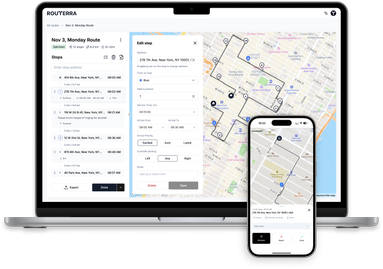
On the dispatcher side, Routerra Teams gives you:
- One-click send of optimized routes straight to each driver's app.
- Zones you draw on the map and set as hard rules — allow or exclude them per driver.
- Drag-and-drop to refine a route, reassign a stop, or split a route between drivers, plus export to CSV, XLSX, or PDF.
- Photo, signature and PDF proof of delivery visible stop-by-stop from the dispatcher app, and automatic SMS or email to recipients when a delivery's status changes — using your own templates.
- Live driver tracking and live status — each driver's position on the plan map while a route runs, each delivery update as it happens (delivered or not-delivered with a reason), a tracking link for your customers, and a full activity log of who did what and when.
For teams with their own systems, Teams also includes signed webhooks, a public Optimize API with API keys, and a data-source connection — a real developer platform at a small-fleet price, not an enterprise upsell.
You can read the full breakdown on the fleet dispatch software page.
Where Routerra Teams may not fit: if you need more than ~20 vehicles self-serve, look further down this list.
RoadWarrior for Teams — familiar to drivers who already use it
Best for: teams whose drivers already know RoadWarrior as a solo app and want a natural step up.
RoadWarrior is a long-standing route planner with a well-known solo app and a "For Teams" fleet product. Its team tool follows the pattern of a base platform plus per-driver seats, and it's a genuinely reasonable choice — especially if your drivers already use the RoadWarrior app individually and you want continuity.
The thing to check carefully is what's bundled versus billed extra. RoadWarrior is one of the tools in this category that has historically treated proof-of-delivery as a paid add-on rather than an included feature. That's not a dealbreaker — it's a math problem. Add the base fee, the per-driver charge, and any add-ons you'd actually turn on, then compare that all-in total against an everything-included plan for the same driver count. Check roadwarrior.app for current pricing and which features sit on which tier.
OptimoRoute — strong optimization for planning-heavy operations
Best for: operations that lean on sophisticated planning constraints and scheduling across days.
OptimoRoute is positioned around planning depth — it's known for handling complex constraints, capacity, time windows, and multi-day scheduling well. If your bottleneck is the plan itself — lots of stops, tight windows, tricky capacity rules — this is a category it competes in seriously.
As with any tiered tool, run the two checks that matter for a small fleet: total cost at your driver count, and whether the specific capabilities you need (proof-of-delivery, notifications) are on the plan you'd buy or a more expensive one. Confirm current pricing and tier contents on optimoroute.com.
Routific — a clean, approachable planner with a strong optimization story
Best for: small teams that want an approachable, well-designed planner and a simple day-to-day flow.
Routific has built a reputation on clean design and a strong optimization pitch — its before-and-after "fewer miles" story is one of the most effective visuals in the category, and the product is generally easy to get started with. For a small fleet that values a straightforward planning experience, it's a real contender.
Weigh it on the same axes: total per-driver cost for your fleet, and whether proof-of-delivery and customer notifications are included at the tier you'd choose. Check routific.com for current plans.
Onfleet — more operations platform than small-fleet tool
Best for: larger or fast-scaling delivery operations that need a heavier operations platform.
Onfleet is a capable, well-regarded delivery management platform, but it's aimed higher up the market than a one-to-twenty-van fleet. It tends toward the "contact sales" end of the spectrum rather than transparent self-serve per-seat pricing, and its feature set and price point suit operations that have outgrown a lightweight tool.
If you're a small fleet, that's the honest read: Onfleet may be more platform (and more cost) than you need today. If you're scaling fast and expect to be well past twenty vehicles soon, it's worth a look. Check onfleet.com for current pricing, which is typically quote-based.
Which alternative is right for you?
- A fleet of one to twenty vehicles that wants one price with everything in it. Routerra Teams at $25/driver/month ($20 annual), no minimum, with an offline-first driver app and proof-of-delivery plus notifications included. Line it up against Spoke Dispatch on total cost for your driver count and what's bundled versus billed extra.
- Drivers who already use RoadWarrior solo. RoadWarrior for Teams is a natural step up — just add up the base fee, per-driver charge, and any add-ons (proof-of-delivery included) before you compare.
- Planning-heavy operations with complex constraints. OptimoRoute competes hard on optimization depth; check tier contents for the features you need.
- A small team that wants a clean, simple planner. Routific is approachable and design-forward; confirm what's included at your tier.
- A larger or fast-scaling operation. Onfleet is a heavier platform aimed above the small-fleet segment; expect quote-based pricing.
The bottom line
Spoke Dispatch is a solid fleet product, but it's one option among several — and for a small fleet, the winner usually isn't decided by a feature checklist. It's decided by two quieter things: the total you pay per driver once the add-ons are counted, and whether the driver app keeps working where your drivers actually go.
That's where Routerra Teams aims to win — one transparent per-seat price with everything included, an offline-first driver app that keeps working where the signal doesn't, and proof-of-delivery and customer notifications you don't pay extra to unlock. Whatever you're weighing it against, do the same thing every time: put the two plans you'd actually buy side by side, count what's included, price it for your real driver count, and decide from there.
Want to see the fleet product in detail? Head to Routerra Teams and start a free trial.